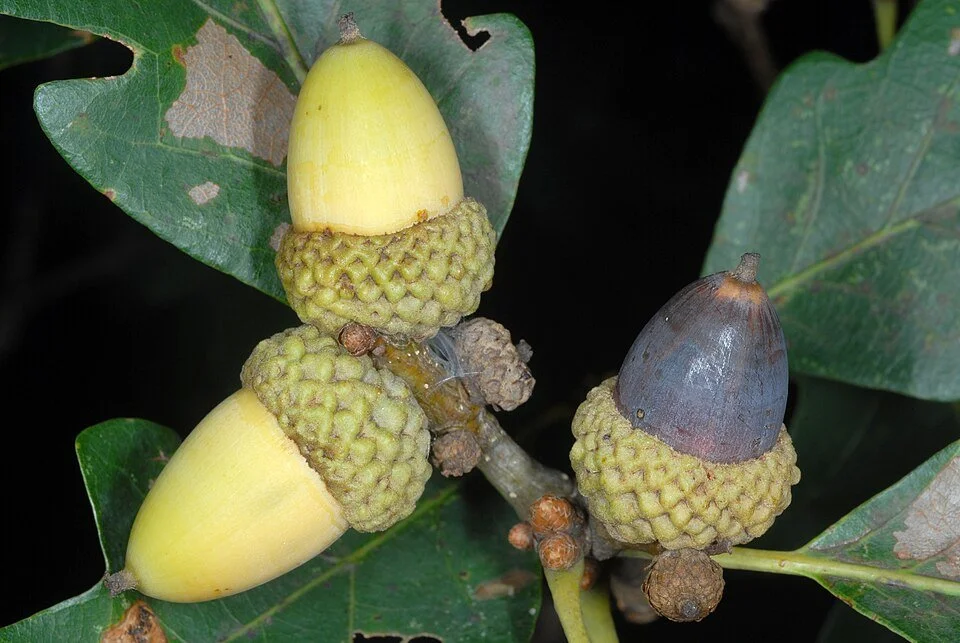
White Oak
The storied white oak grows primarily in the eastern United States and into Canada. The name derives from light-colored bark and the under-surface of leaves. They grow in forests and open spaces, gaining greater height when surrounded by other trees, while expanding the breadth of leaf-filled crowns in the open.
They are the largest trees in their natural region. Many live for centuries, with specimens measured at 200 feet and 500 years. Their acorns feed a multitude, and their trunks, branches, leaves, and roots support creatures beyond number. Humans value it for building ships, wine and whiskey barrels, furniture and any other object requiring hard and handsome lumber. Although long-lived, the tree grows slowly.
Right now, 75% of existing white oaks are mature. Their habitats suffer from climate change, crowding by invasive species, and development. For the majestic white oak to be a feature enjoyed by our descendants, aggressive efforts to plant more seedlings must become a priority for foresters.
Resources: https://en.wikipedia.org/wiki/Quercus_alba, https://en.wikipedia.org/wiki/Quercus_alba, https://www.srs.fs.usda.gov/pubs/misc/ag_654/volume_2/quercus/alba.htm
What do you love about this particular creature?
What do they reveal to you about God and our faith?
Oaks summon awe.
The ancient world saw oaks as paths to the divine. Abraham chose to build his first altar by the oak of Mamre. Three American states exalt the white oak as an icon of their histories. One naturalist wrote, “If oak is the king of trees, as tradition has it, then the white oak, throughout its range, is the king of kings.” This royal more-than-human creature lives for centuries, towering over arboreal neighbors, feeding and sheltering multitudes.
The mature white oak radiates strength, generosity, and persistence, enduring with resilient majesty, teaching how we humbler humans may thrive, in community and in spirit. With roots searching below and branches dancing above, the white oak embodies our Christian rootedness in story and communion, and our call to move with the winds of the spirit, so we may act to make the world whole.
Author - The Rev. Norman MacLeod
The Rev. Norman MacLeod, a lover of trees, serves as co-chair of the Creation Care Ministry in the Diocese of Rhode Island. He lives in Newport, on the edge of the Atlantic Ocean.
Blessed Almighty God, who enables both spiritual and natural surprises, help us to appreciate the surprise and unique beautiful intricacies of each fairyslipper orchid, and to do the work needed to maintain their hidden wetlands, so that future generations may continue to experience your glory.