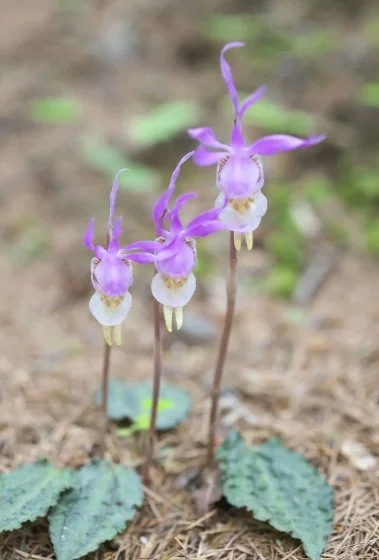
Image from Britannica
Eastern Fairy Slipper Orchid
(Calypso bulbosa)
Fairy-slipper is a rare orchid in New England, being found only in northern white-cedar-dominated swamps in Maine, New Hampshire, and Vermont. Calypso takes its name from the Greek signifying concealment, as these orchids tend to favor sheltered areas on conifer forest floors.
It produces a solitary basal leaf in the autumn that stays green through the winter, and then the solitary flower (rarely 2) is produced in the late spring, usually pink, magenta, or white, with a pouch-like lip that can be spotted with contrasting colors such as yellow. North American native peoples have used the root corms as a food source; their structure suggests that the species is dependent on mycorrhizal relationships with soil funguses for germination and growth.
Resources: https://en.wikipedia.org/wiki/Calypso_bulbosa, https://goorchids.northamericanorchidcenter.org/species/calypso/bulbosa/, https://gobotany.nativeplanttrust.org/species/calypso/bulbosa/
What do you love about this particular creature?
What do they reveal to you about God and our faith?
These orchids are always a surprise to me. As I walk through the woods in late springtime, when the trees are leafing out, I am no longer looking for spring wildflowers, as most are finished blooming, and then this beautiful pink flower with intricate combinations of colors and shapes pops into view, seemingly out of nowhere.
God can be surprising too, popping up when I am not expecting the Almighty’s presence, and revealing new combinations in Creation. Maybe each Calypso sighting can be a reminder to be open to spiritual surprises, seemingly hidden but just waiting to be discerned.
Author - Letty Naigles
Letty Naigles is a retired professor and master-gardener-in-training. She lives in Northeastern Connecticut and enjoys hiking the woodlands all around New England.
Blessed Almighty God, who enables both spiritual and natural surprises, help us to appreciate the surprise and unique beautiful intricacies of each fairyslipper orchid, and to do the work needed to maintain their hidden wetlands, so that future generations may continue to experience your glory.