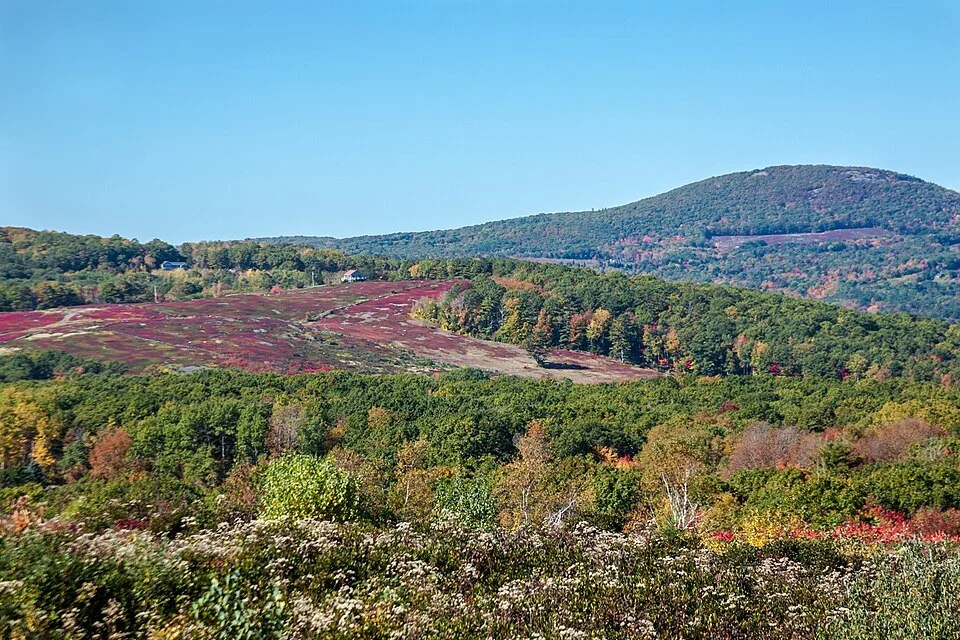
Photo by Paul VanDerWerf
Low-bush Blueberry
The wild blueberry is the fruit of this abundant, low-growing, variable shrub, prevalent throughout the Northeast. It is truly an amazing species. In landscapes scraped by ancient glaciers, it evolved to thrive in low-nutrient, drought-stressed, and fire-prone environments. It adapted to harsh conditions by forming a symbiotic relationship with mycorrhizal fungi, helping it to absorb nutrients. An important re-colonizer, it can rehabilitate sites damaged by industry, sprouting up dense new growth where there has been harm from clearcutting, burning, and over-grazing. Tolerant of both acid rain and acidic, thin soil, its tap roots and woody rhizomes help prevent erosion.
The Blueberry provides essential nutrition for a wide variety of other living things. Mice and moose share its leaves with hundreds of species of caterpillars. Birds from grouse to gulls benefit from eating the fruit, as do humans. It can be a long-lived shrub, some individual clones living for two centuries or more. The majority of its biomass exists below ground, allowing it to quickly regenerate its aboveground leaves and flowers, and its sweet, iconic berries.
What do you love about this particular creature?
What do they reveal to you about God and our faith?
“There lives the dearest freshness deep down things,” said the Jesuit poet Gerard Manley Hopkins in his poem “God’s Grandeur.” Indeed, the lowly, familiar blueberry bush bears witness to the amazing persistence of the life God created. The blueberry speaks to me of the endurance which gains salvation, the healing and rebuilding that we share in the resurrection.
Even in great hardship and with few resources, the blueberry thrives, because of the greenness of God in which it is rooted. But it does not thrive for itself alone: in its renewed growth it bears beautiful leaves that nurture both moose and caterpillar, and those sweet, delicious berries, chock full of antioxidants, that support birds, bears, and humans alike.
The low bush blueberry gives me hope that despite the damage we have done to God’s beautiful creation, repair and rehabilitation are possible. Next time I see a “blueberry barren,” I will lie down amongst the Vaccinium angustifolium and pray that my own soil, stricken by waste, devastated by greed, and visited by fire, will nevertheless find buried deep within it the strength to blossom and to bear fruit, to the glory of God.
Author - The Rev. Dr. Jenny Reece
The Rev. Dr. Jenny Reece is grateful for her life in retirement in which she serves several churches as supply priest, facilitates the Creation Care Team of the Diocese of Maine, and runs a retreat center on the banks of the Narramissic River in Orland, Maine. This river, running from Lake Alamoosook to Penobscot Bay, is among the ancestral fishing grounds of the Wabanaki "People of the Dawn." The beautiful blueberry barrens and rocky shores of this part of coastal Maine remind her of her homeland in Scotland.
God of abundant life, who raised Jesus from the dead, we thank you for the regenerating power of your love. Send us your Holy Spirit, that, sinking our roots deep into compassion, we may burst forth in new life, bearing sweet fruits of peace, justice, and humility with which to repair and nourish the world. We pray for this, and for the endurance of the blueberry bush, in the name of our Risen Savior, Jesus Christ, who with you and the Spirit, is our One God, the author of all creation, now and forever, Amen.