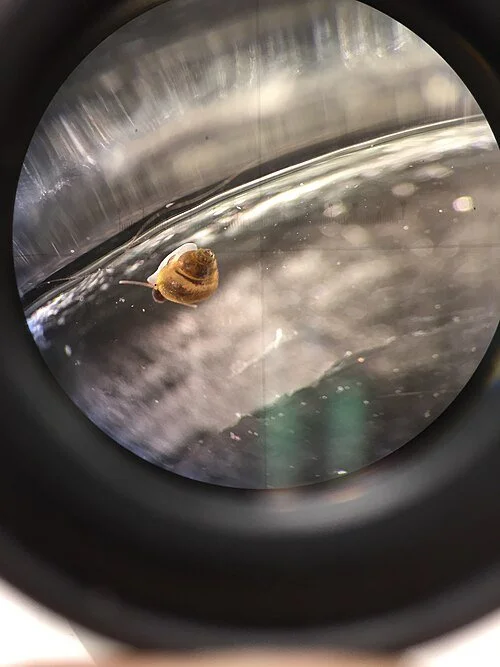
Photo by USFWS/Southeast
New England Silt Snail
The New England Siltsnail (Floridiba winkley) averages 4.8 mm long and 3.1 mm wide. Its tiny trap door, called an operculum, is used to close itself inside to keep from drying out when the tide goes down. Unable to survive in the ocean or on dry land, the New England Siltsnail lives in the coastal waters from Northern Massachusetts to the Mid-coast of Maine. It makes its home in mudbanks, tidal pools, and marshes where it finds nourishment in tiny bits of dead plants and animals attached to the various surfaces it encounters. While Silt snails as a group date back much further than the last ice age, the New England Siltsnail owes its current habitat to the retreat of the glaciers. Living in Coastal Waters, they are vulnerable to sea level rise, water pollution, and human building along the shore. In Massachusetts, they have been identified as a “species of concern, and in Maine a “priority three species of greatest interest.”
What do you love about this particular creature?
What do they reveal to you about God and our faith?
The first thing I love about the New England Siltsnail is the perfect beauty of its whorled shell. We are accustomed to seeing beauty in the larger aspects of creation, but to discover beauty in such tiny fellow creatures moves my heart. The other thing that moves me is the thought of how many Eons these tiny creatures have been contented to live in these coastal waters. It brings to mind how important it is for us to know, love, and be contented with our own local environment.
Author - Margaret Sipple
Margaret Sipple is a member of Trinity Church in Branford, Connecticut, where she coordinates a parish Creation Care Team and serves as a member of the Diocese of Connecticut’s Creation Care Network. Having grown up in Western Maine, she lives near the shoreline of the Long Island Sound where she continues to enjoy learning more about life in coastal waterways.
Loving God, we give thanks for your tiny beautiful ones who in their own way contribute to the well-being of their local environment. May we learn from their example and do our own part to help sustain the gift of life on our beloved planet. In the name of Jesus we pray. Amen