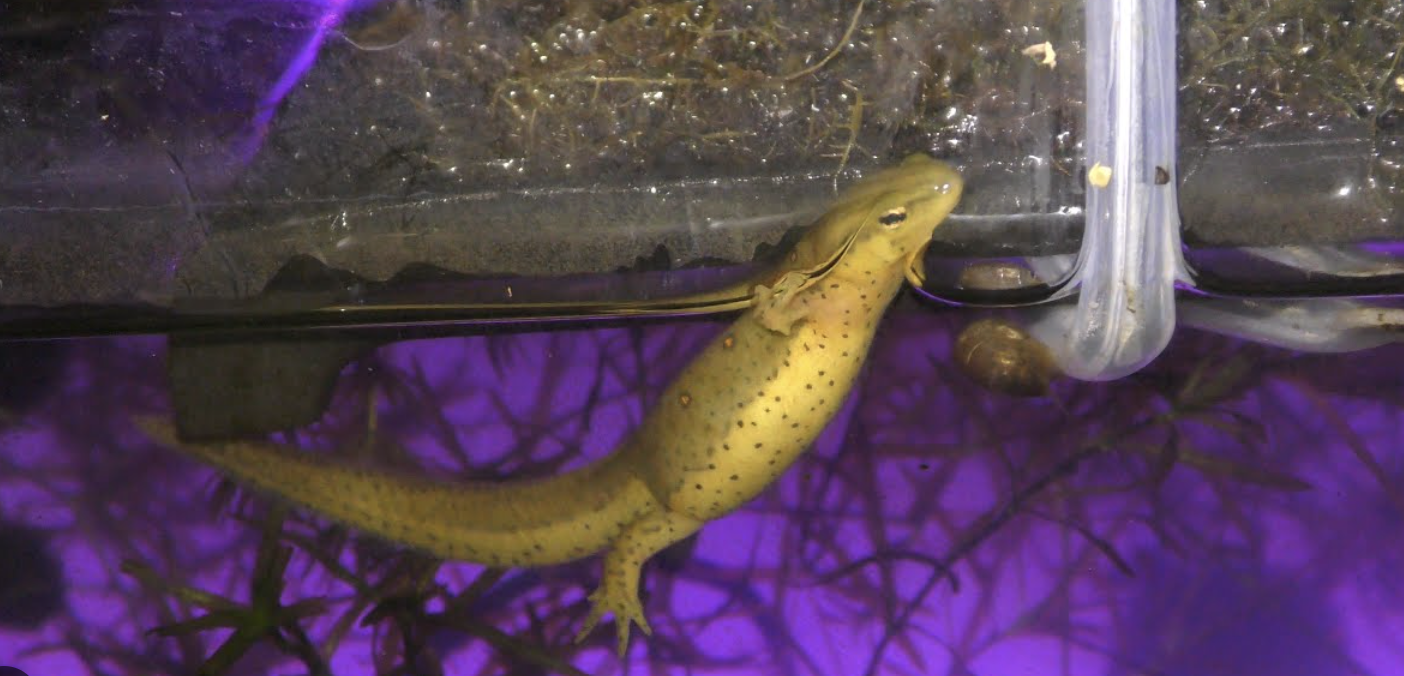
Eastern Newt
Eastern newts are native to the U.S. The bright orange salamanders you see sneaking under leaves are in their second stage of life, called an eft. They start out emerging from eggs attached to water plants in ponds and bogs. In this first stage of life, called aquatic larvae, they have gills. In just a few months, they develop into their eft form. As efts, they can roam long distances for a few years looking for new water sources to lay their eggs, where they enter their third stage of life as aquatic adults, although some groups have been found to stay efts their whole lives, only going back to the water to breed. Newts can live up to 15 years. I often wondered how their bright color kept them safe. The secret is in the slightly toxic red dots on their skin.
Eastern newts are carnivorous at every stage of life, feeding on a variety of available invertebrates, including aquatic insects like mosquitoes.
What do you love about this particular creature?
What do they reveal to you about God and our faith?
Newts and other amphibians are early detectors of environmental problems. If their numbers are reduced in an area where you used to see lots of them, something in the environment has changed, and not for the better. They are affected by pollution, development (fragmentation, toxic lawns and chemical runoff), and climate change (especially drought).
These tiny creatures travel alone, counting on their God-given instinct to get them where they need to go. Seeing them in my garden and along trails always brings me joy. In nature, all creatures have a job to do, and newts' job, keeping mosquito populations in check, is one I truly appreciate. All of us have a calling. In our prayers, let's listen to God's will for our lives. It might be different from what society has guided us to.
Author - Joan Garuti
Joan Garuti lives in the forest of Unity, NH, alongside newts and all sorts of wildlife, and with her husband, dogs, horses, chickens, and guineas.
Creator God, thank you for giving us the life example of the Eastern Newt. We only knew them as bright-colored landlubbers. Now we know they spend most of their life in the water, and their skin is usually a greenish brown, not the bright orange we so easily spot in the forest. They gracefully rearrange their life and change their appearance three times. Help us to learn that change is good and that under our skin we are all exactly who God wants us to be at any given time in our lives. Just like the newt keeps its red dots as a constant protection throughout its life, help us to remember you are always with us to guide and guard us through the changes of our lives. Help us preserve places where newts and other amphibians can thrive. For all creatures great and small, we give you thanks and praise through Jesus Christ our Lord. Amen