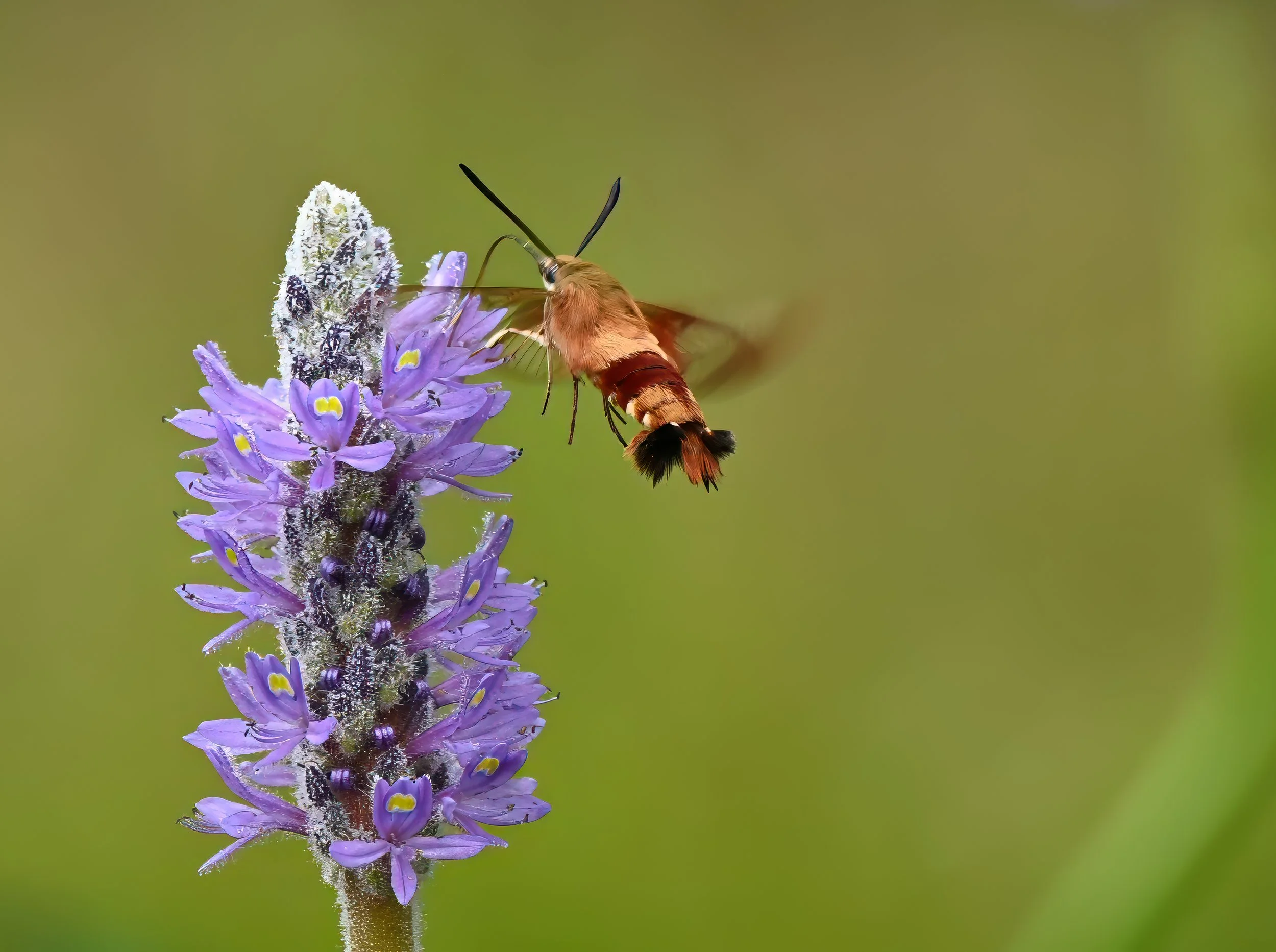
Photo by George Seiffert
Hummingbird Moth
Hummingbird moths are members of the sphynx, or hawk moth family. They are diurnal nectar eaters and important pollinators. Although they resemble hummingbirds, they may not have evolved as a mimic but are similar due to convergent evolution, having developed similar traits independently. Adults feed on a variety of flowers, but larvae of each species are obligate to a few types of plants, including honeysuckles, dogbane, hawthorn, cherries, and plums.
Resource: New England Botanic Garden
What do you love about this particular creature?
What do they reveal to you about God and our faith?
One year, when I was a summer teacher/naturalist at a Massachusetts Audubon day camp, I had a camper named Sam. He was all about insects. His father warned us he would wander off to follow one bug or another. One day he did just that. I found him next to a bush, mesmerized, pointing and excitedly whispering, “Hummingbird moth! Hummingbird moth!” I had never seen one before, but was instantly enamored.
I now look for them on my bee balm when it is in flower. The shaggy, deep flowers are perfect for their long proboscises. Hummingbird moths are a jewel of evolution. Fat-bodied, yet nimble, wings fluttering in a blur, so easily mistaken for a true hummingbird. God’s gift of the variety of pollinators each summer humbles me. I thank God and Sam for making me aware of, and to feel deep compassion for, such a magical insect.
Author - Anneliese Mepugh
Anneliese (Lili) is a member of St. Andrew's Church in Newcastle, ME, and a recent postulant to the diaconate. She lives in the Midcoast of Maine, land of the Abanaki and the Sheepscot River.
O God, maker of winged creatures, you who make all things possible, the momentum for great diversity of life, help us to keep open to the possibilities the hummingbird moth exemplifies in the great diversity of pollinators. May we be ever curious like Sam, open to exploration and greater understanding, seeking the small as well as the great wonders of our natural world. Our hearts ever open to you, our savior and redeemer.